
At Scopious IoT, LoRaWAN is one of the core wireless technologies we use to connect sensors, assets, and monitoring devices across New Zealand. Its long range, low power consumption, and ability to operate in remote environments make it ideal for applications including environmental monitoring, water management, asset tracking, infrastructure monitoring, and smart agriculture.
Whether you're new to LoRaWAN or comparing different IoT connectivity options, this guide explains how LoRaWAN works, its benefits, and why it has become one of the world's leading low power wide area network (LPWAN) technologies.
LoRa
Type of hardware that supports long-range wireless communication.
LoRaWAN
Network protocol based on LoRa.
Together, LoRa & LoRaWAN allow long-range, low-power applications to be built for IoT, enabling wireless transmission over distances of up to 15km! Among other benefits and features shown below, they are also suitable for a wide range of applications; indoors and outdoors.
If you’ve spent any time in the LoRaWAN ecosystem, you’ve likely heard of both The Things Industries (TTI) and The Things Network (TTN).
While the two are closely related, there’s an important distinction between them, one that defines the reliability, scalability, and professionalism of your IoT deployment. Read More

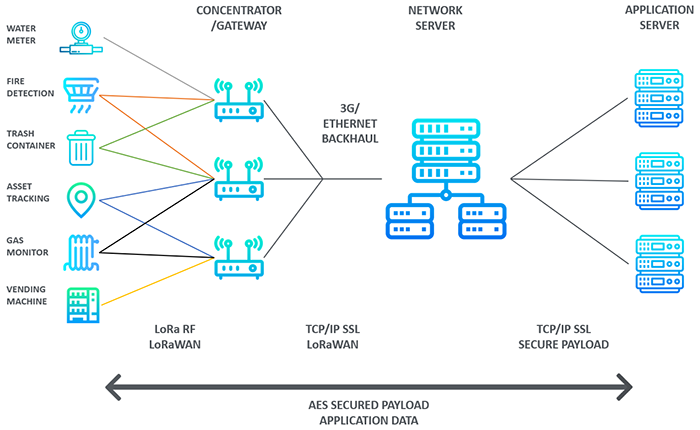
LoRaWAN Gateways and Edge Devices are two of four key components of the LoRaWAN network architecture:
Sensors and Actuators – Represents edge devices
Gateway – Collects or concentrates data from several edge devices
Network Server – Consolidates data from gateways for upload to the application server
Application Server – Processes or displays consolidated data
Deep indoor coverage (including multi-floor buildings)
Star topology network design
Coverage expectations:
Urban environment - 2 to 3km wide coverage, while in the rural areas, it can reach 10 km
Unique low power benefits untouched by other technologies.
Indoor/Outdoor
Accurate without the need for GPS (* specialist infrastructure required)
No battery life impact
Minimal infrastructure
Low-cost end-node
Open-source software
Costs reduce further as technology matures and the marketplace grows
End-to-end AES128 encryption
Mutual authentication
Integrity protection
Confidentiality
Minimal energy consumption
Up to 10-year lifetime - ideal for remote locations
Low-power optimised
Up to 10x versus Cellular M2M
Ideal for remote NZ locations
Roaming seamless handovers from one network to another
High capacity - millions of messages per base station/gateway
Multi-tenant interoperability
Public or private network deployments
Offers device interoperability and global availability of LoRaWAN networks for speedy deployments of IoT applications anywhere.
LoRaWAN (Long Range Wide Area Network) is a wireless communication protocol designed for low power IoT devices. It enables sensors and other devices to transmit small amounts of data over long distances while using very little battery power.
LoRa is the wireless radio technology that sends data over long distances. LoRaWAN is the networking protocol that manages how LoRa devices communicate with gateways, network servers, and applications.
A LoRaWAN gateway receives messages from nearby LoRa devices and securely forwards them to a network server over an internet connection. One gateway can typically support thousands of sensors across a large area.
Typical coverage is around 2 to 5 km in urban environments and 10 to 15 km or more in rural areas, depending on terrain, antenna placement, and environmental conditions.
Many LoRaWAN sensors operate for five to ten years on a single battery because devices spend most of their time in low power sleep mode and only transmit small amounts of data when needed.
Yes. LoRaWAN uses AES-128 encryption with authentication between devices and the network, helping protect data throughout transmission.
The sensors themselves do not require a direct internet connection. Instead, they communicate with a LoRaWAN gateway, which connects to the internet and forwards data to the IoT platform.
LoRaWAN is widely used in water management, environmental monitoring, agriculture, utilities, manufacturing, smart buildings, asset tracking, local government, and infrastructure monitoring.
Scopious IoT uses LoRaWAN because it provides reliable long range connectivity, excellent battery life, and cost effective deployment for remote monitoring applications across New Zealand. Combined with the Scopious IoT platform, LoRaWAN enables organisations to collect sensor data, monitor assets, receive alerts, and visualise information from almost anywhere.
Yes. Scopious IoT supports a wide range of LoRaWAN sensors and gateways, allowing organisations to connect compatible devices to the platform for monitoring, alerts, dashboards, and reporting.
Reality: LoRa and LoRaWAN work together, but they are not the same technology.
LoRa is the wireless radio technology that enables long range, low power communication between devices.
LoRaWAN is the networking protocol that manages how those devices securely communicate with gateways, network servers, and IoT applications.
Together, LoRa and LoRaWAN provide the foundation for reliable, long range IoT connectivity, supporting applications such as environmental monitoring, asset tracking, water management, and smart infrastructure.
Reality: LoRaWAN is designed for long range communication, making it ideal for monitoring assets across large sites and remote locations.
The range of a LoRaWAN network depends on factors such as terrain, buildings, antenna placement, gateway location, and the amount of data being transmitted. Typical coverage includes:
Urban environments: around 2 to 5 km
Rural environments: 10 to 15 km or more under favourable conditions
Because LoRaWAN uses sub-GHz radio frequencies, signals can travel much further than many other wireless technologies and often penetrate buildings and vegetation more effectively.
For the best performance, gateways are typically installed in elevated locations with a clear line of sight to the surrounding area.
Reality: Many LoRaWAN devices can operate for five to ten years on a single battery, depending on the application and how often they transmit data.
LoRaWAN is designed for low power operation. Most devices spend the majority of their time in a deep sleep mode, only waking briefly to collect sensor readings and transmit small amounts of data before returning to sleep.
Battery life depends on several factors, including:
How often the device sends data
The type of sensor being used
Environmental conditions
Battery size and quality
This exceptional battery efficiency makes LoRaWAN an ideal choice for remote monitoring applications where mains power is unavailable or frequent battery replacement is impractical.
Reality: LoRaWAN is designed for small, low-bandwidth data messages, not large files.
LoRaWAN transmits very small packets of data at low data rates to maximise range and battery life. This makes it ideal for sensor readings, alerts, and status updates, but not suitable for images, video, audio, or file transfers.
Typical LoRaWAN use cases include:
Environmental sensor readings (temperature, humidity, rainfall)
Asset status updates
Alarm triggers and notifications
GPS or location pings
Because of these constraints, LoRaWAN is highly efficient and can support long battery life and wide area coverage across remote locations.
Reality: LoRaWAN supports bidirectional communication, meaning devices can both send data and receive commands.
An end device (such as a sensor or tracker) can transmit information like temperature, location, or status, and it can also receive instructions from the network. This allows systems to remotely control devices, trigger actions, or update configurations over long distances.
This makes LoRaWAN suitable not only for monitoring, but also for control-based applications such as remote alerts, automation, and infrastructure signalling.
For example, a sensor could detect flooding at a site and send an alert, while a connected indicator at another location could receive a command to display a warning or trigger a response.
Reality: Security is not handled by LoRa itself, but by LoRaWAN, which includes built-in encryption and authentication.
LoRa is the underlying radio technology used to transmit data over long distances. Security is provided at the LoRaWAN protocol level, which sits above the radio layer.
LoRaWAN uses end-to-end AES-128 encryption and separates security into two layers:
Network security, which ensures only authorised devices can connect to the network
Application security, which ensures only the intended application can read the data
This means data remains protected as it travels from device to application, even when using shared infrastructure such as gateways and network servers.
Reality: LoRaWAN itself is an open standard, and you don’t necessarily need to pay to get started.
There are public community LoRaWAN networks available in some regions that allow users to connect compatible devices without deploying their own infrastructure. In these cases, you only need end devices to begin testing or small-scale use.
However, many real-world deployments use private or managed LoRaWAN networks to ensure better coverage, reliability, security, and scalability. These setups typically include dedicated gateways, network servers, and application platforms tailored to business requirements.
In these cases, costs are associated with infrastructure and platform services rather than the LoRaWAN technology itself.
Reality: While LoRaWAN is widely used in industrial IoT (IIoT), its applications extend far beyond simple sensor monitoring.
LoRaWAN is designed for low power, long range communication, which makes it suitable for any application that involves small amounts of data transmitted across wide or remote areas.
Today, LoRaWAN is used across a wide range of industries and use cases, including:
Environmental monitoring (water quality, rainfall, air quality)
Agriculture and smart farming (soil moisture, irrigation control, livestock tracking)
Utilities and infrastructure (water networks, energy monitoring, remote pump stations)
Smart cities (lighting, waste management, parking sensors)
Asset and equipment tracking across large or remote sites
Building and facilities monitoring
Rather than being limited to industrial sensors, LoRaWAN has become a general-purpose connectivity technology for remote, distributed, and low-power IoT applications.
Reality: LoRaWAN is backed by a large and growing global ecosystem of technology providers, network operators, and device manufacturers.
The LoRaWAN standard is governed by the LoRa Alliance, an international industry body that includes hundreds of member organisations across hardware, software, and connectivity sectors.
This broad ecosystem ensures LoRaWAN remains a stable, interoperable standard with ongoing development, global adoption, and support across multiple industries and regions.
As a result, organisations can choose from a wide range of compatible devices, platforms, and network options when deploying LoRaWAN solutions.
Reality: LoRaWAN devices can be located without GPS, but the accuracy depends on the network design and infrastructure.
Instead of relying on GPS modules (which increase cost and reduce battery life), LoRaWAN can estimate device location based on signals received by multiple gateways. This is known as network-based or “GPS-free” positioning.
In well-designed networks, this can provide location accuracy ranging from broad area estimates (such as a site or zone) through to more precise positioning, depending on gateway density and placement.
This approach is particularly useful for asset tracking applications where battery life, cost, and simplicity are more important than pinpoint GPS accuracy.
Reality: There is a wide and growing ecosystem of LoRaWAN devices and gateways available for almost every type of application.
LoRaWAN has strong global hardware support, with manufacturers producing sensors, trackers, and gateways designed for a broad range of use cases, including environmental monitoring, agriculture, utilities, smart infrastructure, and asset tracking.
Most applications can be supported using off-the-shelf LoRaWAN devices, and in cases where specialised requirements exist, custom or configurable hardware options are also available through the wider ecosystem.
With the right platform and guidance, it is usually possible to match suitable LoRaWAN hardware to the specific requirements of a project, rather than building from scratch.
